
ISO 14001 Certification for Cleveland Manufacturers
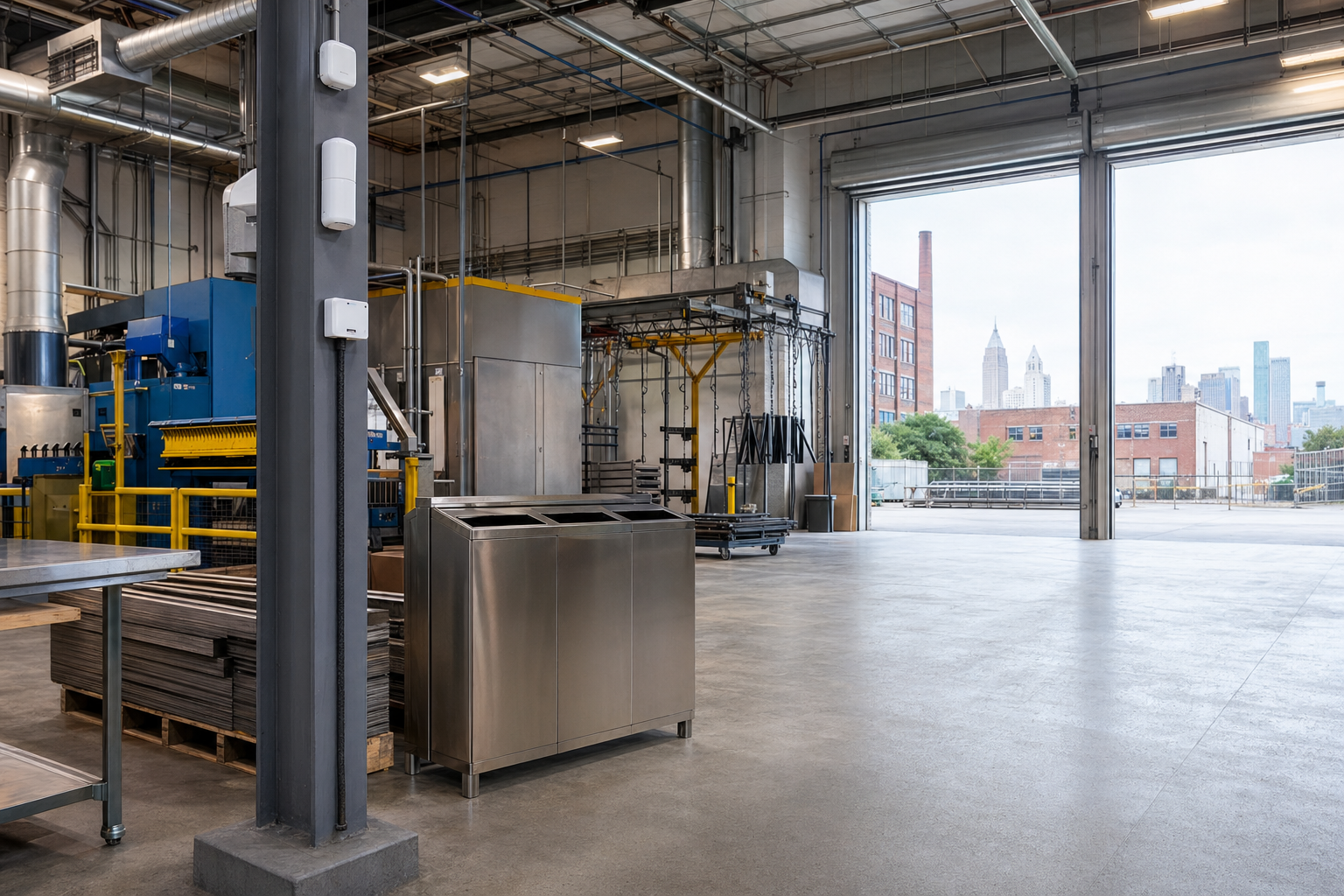
Cleveland sits at the heart of America's industrial Midwest — metal fabrication, plastics, chemicals, machine tools, paint and coatings, automotive parts, and a growing battery and EV-component supply chain stretching across Cuyahoga, Lorain, Lake, and Geauga counties. For most of those operations, environmental compliance is no longer optional. ISO 14001:2015 is the bar customers, regulators, and insurers expect from any Ohio plant that handles solvents, coatings, metal finishing, plastics, or waste streams — and OEM supplier scorecards increasingly require it before they award production work.
PinnacleQMS helps Cleveland-area manufacturers earn ISO 14001 certification cleanly: with an AI-powered compliance platform, an accredited domain expert who visits the facility, and a dedicated project manager who stays with the engagement from gap assessment through Stage 2 audit. This page covers how the process works in the Ohio market, what it costs in US dollars, and what to expect from an ANAB-accredited registrar audit covering the EPA, OSHA, and Ohio EPA layers your facility already operates under.
Why ISO 14001 matters for Cleveland manufacturers
The Ohio manufacturing belt operates under one of the densest environmental regulatory regimes in North America. Ohio EPA permitting for air emissions, water discharge, and hazardous waste sits on top of US EPA Title 40 rules — Resource Conservation and Recovery Act (RCRA), Clean Air Act (CAA), Clean Water Act (CWA), and the Toxic Substances Control Act (TSCA). For manufacturers in Cleveland, Akron, Toledo, Youngstown, and the broader I-71 / I-77 corridor, ISO 14001:2015 is the framework that ties all of those obligations together into one auditable system.
The reasons GTA-area Ohio plants pursue certification:
- Customer mandate. Tier 1 automotive customers (Ford, GM, Stellantis, Honda — the latter in Marysville) increasingly require ISO 14001 alongside IATF 16949 for production-parts suppliers. Aerospace primes (GE Aerospace in Evendale, Parker Hannifin in Cleveland) require similar environmental commitments from their supply base.
- Permitting and inspection leverage. Ohio EPA and US EPA inspectors give meaningful credit to facilities operating under a certified ISO 14001 system — fewer surprise inspections, faster permit turnaround, and softer enforcement when minor violations occur.
- Insurance and lending. Property and environmental liability carriers price ISO 14001-certified operations measurably lower than uncertified peers — typically 8 to 15% on the environmental-liability portion.
- Customer ESG reporting. Public-company customers (and increasingly private-equity-owned customers) need supplier environmental data for their own ESG disclosures. An ISO 14001 certificate is the cleanest evidence available.
- Operational discipline. Most growing Ohio fabricators have technical debt in waste-stream tracking, chemical inventory, and air-permit compliance. ISO 14001 forces clarity on each of those.
If your customers have started asking about Scope 1, Scope 2, or environmental management certifications, this page is for you.
Common ISO 14001 implementation challenges in Ohio manufacturing
Cleveland-area manufacturers tend to share a few patterns that make ISO 14001 implementation more complex than the textbook rollout suggests. PinnacleQMS consultants have seen all of these on Ohio shop floors:
- Mixed-permit facilities. A typical Cleveland fabrication operation holds multiple Ohio EPA permits — Title V for major air sources, NPDES for stormwater discharge, RCRA for hazardous waste generator status. The QMS has to absorb every permit obligation without smothering daily operations in paperwork.
- Legacy contamination concerns. Older industrial sites along the Cuyahoga River and in the Flats carry historical contamination liability. ISO 14001 risk-and-opportunities registers must address remediation, monitoring well sampling, and reporting obligations explicitly.
- Solvent and coating operations. Paint and coating operations under HAPS (Hazardous Air Pollutants) rules need air-emissions tracking that maps cleanly to clause 6.1 (risks and opportunities) and clause 9.1 (monitoring, measurement). Manual logging on spreadsheets typically fails at the first surveillance audit.
- Hazardous waste accumulation. RCRA generator status (small, large, very-small-quantity) determines storage limits, training requirements, and reporting cadence. Crossing thresholds without updating the QMS is a common audit finding.
- Stormwater and SPCC compliance. Ohio's Lake Erie watershed adds stormwater management complexity. Spill Prevention, Control, and Countermeasure (SPCC) plans for facilities with above-ground petroleum storage must be referenced in the QMS document control system, not stored in a binder no one updates.
The platform handles each of these at the system level, and the consultant-led implementation makes sure the documented operational controls match what is actually happening on the floor.
Our 6-stage certification process
Whether the facility is starting from scratch or migrating an existing environmental management system onto our platform, certification moves through six stages. The full walk-through is on the main process page; here is the Cleveland-specific summary.
- Gap assessment. An accredited auditor visits the Cleveland facility (or audits remotely with live video where preferred). The output is a clause-by-clause report against ISO 14001:2015 with a compliance score, an environmental aspects-and-impacts inventory, and a prioritised action list mapped against Ohio EPA permit obligations.
- Aspects and impacts assessment. The most distinctive stage of an ISO 14001 implementation. Every product, process, and support activity gets evaluated for its environmental aspects — air emissions, water discharge, waste, energy, raw material consumption, land use — and significance ranked.
- QMS design and documentation build. The platform generates draft policies, procedures, operational controls, and emergency response plans tailored to the specific permit profile. Existing SPCC, Title V, NPDES, and RCRA documentation gets folded into the QMS rather than running in parallel.
- Implementation and training. Operators, supervisors, environmental staff, and management get role-specific training. Records get pulled into the platform so the audit trail starts the day the system goes live.
- Internal audit and management review. Before the registrar arrives, our team conducts a full internal audit and runs a management review with leadership. Findings are closed; corrective actions documented; environmental KPIs trended.
- Certification audit. Stage 1 (documentation) and Stage 2 (on-site) audits are conducted by an ANAB-accredited registrar — typically with an Ohio-based or remote auditor. We sit in. Across 250+ certifications, the first-attempt pass rate is 98%.
Total elapsed time depends on facility size, current EMS maturity, permit complexity, and audit scheduling — most Cleveland-area implementations land between five and ten months from gap to certificate.
Industries we work with in the Cleveland area
Our client base in the Cleveland industrial corridor spans the full spectrum of Ohio manufacturing. The certification process is the same; the technical content of the EMS varies sharply by sector and permit profile.
- Metal fabrication and finishing. Stamping, machining, plating, painting, anodizing — the full breadth of metal processing along the Cuyahoga and into Lorain and Akron. Air-permit and hazardous-waste compliance are the heaviest lift.
- Automotive parts and EV components. Tier 2 and Tier 3 suppliers feeding plants in Lordstown, Marysville, Detroit, and the broader Midwest. ISO 14001 frequently combined with IATF 16949. See our automotive industry page.
- Plastics and rubber. Injection moulding, extrusion, compounding for both auto and consumer goods customers along the I-77 and I-90 corridors. Air-emissions tracking under HAPS rules is the bottleneck.
- Chemicals and coatings. Specialty chemicals, paints, coatings, adhesives — high regulatory burden, ISO 14001 essential for customer qualification.
- Aerospace and defence. Cleveland-area aerospace machining, Parker Hannifin supply chain, and DoD-adjacent suppliers. ISO 14001 layered on ISO 9001 — see our aerospace and defence industry page.
- Food processing. Co-packers, bakeries, ingredient producers across northeast Ohio — ISO 14001 frequently combined with FSSC 22000 or HACCP. See our food and beverage page.
For the deeper view across all manufacturing segments, see the manufacturing industry page.
ISO 14001 certification cost and timeline in Cleveland
Costs in the Cleveland market fall into three buckets: consulting and platform on the implementation side, registrar fees on the audit side, and any permit-related remediation surfaced during the gap assessment. The realistic ranges in US dollars:
- Implementation (consulting + platform): typically US$15,000 – US$45,000 depending on facility size, employee count, current EMS maturity, and permit complexity. A small single-site fabrication shop with 30 employees and one Title V permit lands at the lower end; a multi-shift 200-employee operation with multiple permits and historical contamination concerns sits higher.
- Registrar fees: typically US$8,000 – US$22,000 for the Stage 1 + Stage 2 audit and the first surveillance year. Driven by audit-day count, which the registrar calculates from your scope, headcount, and number of significant environmental aspects.
- Ongoing surveillance: US$3,000 – US$8,000 per year for the surveillance audit, plus the platform subscription which folds documentation, internal audits, management review, and aspects-and-impacts updates into one workflow.
Timeline ranges reflect three primary drivers: how clean your current permit documentation is, how disciplined your team is at closing actions on schedule, and how fast the registrar can fit you into their audit calendar (Ohio-belt registrars often book three to four months out, especially during EPA compliance season).
For a deeper cost breakdown across the US, the PinnacleQMS pricing guide walks through every line item.
After certification: surveillance audits and ongoing improvement
The certificate is a three-year milestone, not the finish line. After the initial audit you enter the surveillance cycle:
- Annual surveillance audits. The registrar returns each year to verify the EMS is still operating as designed. The first surveillance is typically twelve months after the certification audit; the second is at twenty-four months.
- Recertification at three years. A full recertification audit at the three-year mark — broader scope than a surveillance audit, but typically a smoother experience because the system has matured.
- Continuous improvement evidence. ANAB-accredited auditors increasingly probe whether the management system is actually producing improvement — measurable reductions in waste, emissions, energy intensity, water use. Aspirational policy without measurable progress is a finding.
- Permit and regulatory change tracking. Ohio EPA and US EPA rules evolve. The QMS must absorb changes within defined review cycles, not at the next surveillance audit.
This is where the platform earns its keep. Document control, internal audits, corrective actions, supplier quality, training records, management review, aspects-and-impacts register — all in one system, with the audit trail pre-built. When the registrar (or the Ohio EPA inspector) walks in, the evidence is already there.
Why Cleveland manufacturers choose PinnacleQMS
A few things separate PinnacleQMS from the small-shop consultancies and the over-engineered enterprise platforms common in the Ohio market:
- 250+ certifications, 98% first-attempt pass rate. Across ISO 9001, ISO 14001, ISO 45001, IATF 16949, AS9100, ISO 13485, FSSC 22000, and ISO 17025.
- Accredited auditors with permit expertise. Lead auditors who have sat on the registrar's side of the audit table at Ohio fabrication, automotive, and chemical facilities — they know what ANAB-accredited registrars and Ohio EPA inspectors actually check.
- On-site presence in northeast Ohio. We visit your facility for gap assessments, internal audits, and registrar audits. Remote work fills the gaps — your team is not stuck on Zoom for nine months.
- Platform you keep using after certification. Document control, internal audits, supplier quality, corrective actions, management review, training, aspects-and-impacts register — all in the same system, year after year.
- Honest scoping. We will tell you when ISO 14001 alone is enough and when you need ISO 45001, IATF 16949, or FSSC 22000 layered on — even if it costs less upfront for us to keep the engagement narrow.
If you want to talk through the specifics of your facility, the contact page takes 30 seconds.
Frequently Asked Questions
How long does ISO 14001 certification take for a Cleveland manufacturer?
Most Cleveland-area implementations land between five and ten months from gap assessment to certificate. The variance is driven by current permit documentation quality, complexity of environmental aspects, how fast your team closes corrective actions, and the registrar's audit calendar — Ohio-belt registrars often book three to four months out.
What does ISO 14001 certification cost in US dollars?
Implementation (consulting + platform) typically runs US$15,000 – US$45,000 depending on size and complexity. Registrar fees for the Stage 1 + Stage 2 audit are typically US$8,000 – US$22,000. Ongoing surveillance is US$3,000 – US$8,000 per year plus the platform subscription. We give a fixed quote after the gap assessment.
How does ISO 14001 align with Ohio EPA and US EPA permit obligations?
ISO 14001 does not replace permits — it organises compliance with them. The QMS becomes the auditable record of how Title V, NPDES, RCRA, and SPCC obligations are tracked, monitored, and reported. Ohio EPA and US EPA inspectors generally extend regulatory deference to certified facilities — fewer surprise inspections and faster permit turnaround in our clients' experience.
Can we get certified remotely or do you need to visit our facility?
The implementation is hybrid. The platform handles documentation, internal audits, training, and management review remotely. The gap assessment, the aspects-and-impacts walk, and at least one site visit during implementation are on-site at your Cleveland-area facility. The registrar's Stage 2 audit is on-site by default; remote audits are possible for some scopes but rare in regulated environmental contexts.
We already have an ISO 9001 certificate — does that simplify ISO 14001?
Yes. ISO 14001:2015 shares the high-level structure of ISO 9001:2015 (the same Annex SL framework — context, leadership, planning, support, operation, evaluation, improvement). A well-built ISO 9001 system covers approximately 60-70% of the documentation needed for ISO 14001. Most of our clients move from ISO 9001-only to ISO 9001 + ISO 14001 in 4-6 months by integrating the two systems rather than running them separately.
