ISO 9001 vs IATF 16949 vs AS9100: Which Standard Does Your Ontario Supplier Plant Really Need?
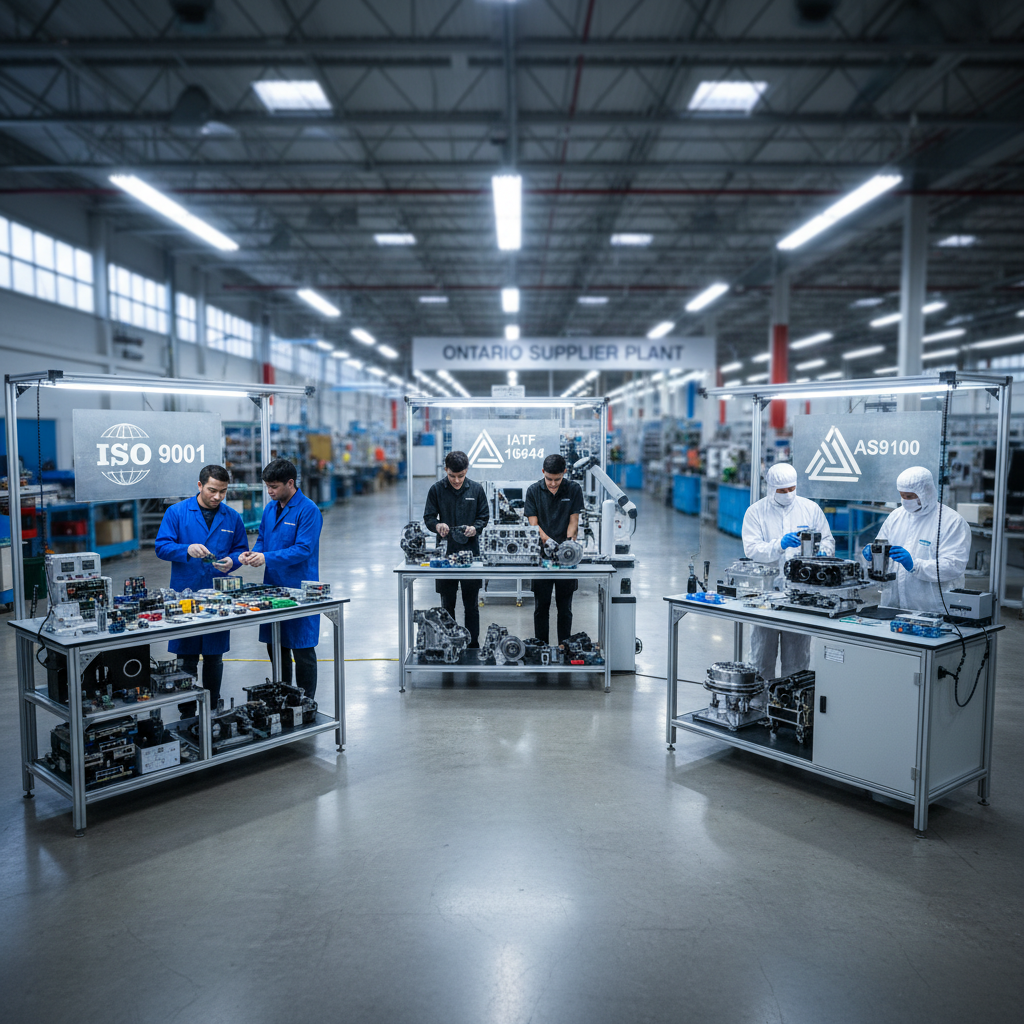
ISO 9001 vs IATF 16949 vs AS9100: Which Standard Does Your Ontario Supplier Plant Really Need?
Key Takeaways
> - ISO 9001, IATF 16949, and AS9100 share a common foundation but serve distinctly different supply chain requirements — choosing the wrong one costs time and money. > - IATF 16949 is mandatory for Tier 1 and Tier 2 automotive suppliers; ISO 9001 alone will not satisfy most OEM customer-specific requirements in 2026. > - AS9100 Rev D builds on ISO 9001 with aerospace-specific risk and configuration controls — it is not interchangeable with IATF 16949 even for dual-sector plants. > - Brampton and the broader Greater Toronto Area supply chain corridor hosts facilities that legitimately need more than one of these certifications simultaneously. > - Total investment varies significantly by standard: implementation scope, employee headcount, and existing process discipline matter more than facility square footage.
The ISO 9001 vs IATF 16949 vs AS9100 comparison comes up in our practice more than almost any other question — and the answer is rarely as simple as "pick the one your customer asked for." A stamping plant in Brampton supplying both a Tier 1 auto parts maker and a defense subcontractor may genuinely need two of these standards running in parallel. A machining shop pivoting from general industrial work into aerospace will find that ISO 9001 is a starting point, not a destination. Getting the selection wrong means investing 12 to 18 months in a certification that either fails to satisfy your customer contracts or overcomplies with requirements that don't apply to your product category.
This article cuts through the overlap to give you a clear picture of what each standard actually demands, where they diverge, and how to make a defensible business decision before you engage a registrar.
What Each Standard Actually Requires

All three standards are built on the Plan-Do-Check-Act framework and share the ISO High Level Structure introduced in Annex SL. That shared architecture is where the similarities largely end.
ISO 9001:2015 establishes the baseline: a documented quality management system covering context analysis (Clause 4), risk-based thinking (Clause 6.1), operational planning (Clause 8), and performance evaluation (Clause 9). It applies to any organization in any sector. For manufacturers supplying non-automotive, non-aerospace customers, it is often the right and sufficient choice, though understanding the ISO 9001 quality management requirements in detail helps inform broader strategic decisions.
IATF 16949:2016 does not stand alone — it must be implemented alongside ISO 9001:2015, not instead of it. The standard adds approximately 100 additional requirements tailored to automotive production, including:
- Control plan methodology linked directly to the Production Part Approval Process (PPAP), requiring documented process controls at every product family level with reaction plans tied to specific defect modes.
- Manufacturing feasibility reviews (Clause 8.3.3.2), which require engineering sign-off before any new product or process change reaches production — a requirement that catches many shops off guard during gap assessments.
- Customer-specific requirements (CSRs) that must be formally incorporated into the Quality Management System (QMS), including CSRs from Ford, Stellantis, GM, Toyota, and other OEMs, each of which publishes separate documentation that becomes contractually binding.
AS9100 Rev D also builds on ISO 9001:2015 but targets aviation, space, and defense supply chains. Its distinguishing requirements include configuration management (Clause 8.1.3), first article inspection protocols, and an elevated focus on risk management that extends to product safety, airworthiness, and counterfeit-part prevention. Unlike IATF 16949, AS9100 explicitly addresses human factors and their impact on product conformity — a clause that surprises manufacturers coming from a purely mechanical production background, particularly when reviewing the AS9100 aerospace quality standards in depth.
Key Consideration
Many Ontario manufacturers assume AS9100 and IATF 16949 are roughly equivalent in rigor. In practice, AS9100's configuration management and first article inspection requirements add documentation layers that automotive-trained quality teams often have no prior experience managing.
ISO 9001 vs IATF 16949: Head-to-Head

| Dimension | ISO 9001:2015 | IATF 16949:2016 |
|---|---|---|
| Applicability | Any industry | Automotive production sites only |
| Standalone | Yes | No — requires ISO 9001 |
| Customer-specific requirements | Not addressed | Mandatory integration |
| PPAP / APQP | Not required | Core requirement |
| Internal audit frequency | Risk-based | Annual per process, per shift |
| Defect rate targets | Not prescribed | Customer-specific (often PPM-level) |
| Special characteristics | Not addressed | Mandated identification and control |
| Certification body | Any IAF-accredited CB | IATF-sanctioned CBs only |
If you are supplying IATF 16949 automotive quality components to any OEM-linked customer, ISO 9001 alone will disqualify you from most supplier portals by 2026. Chrysler, Ford, and GM have maintained IATF 16949 as a hard requirement in their supplier quality manuals for years, and that position has not softened. Registering to ISO 9001 and hoping a customer will accept it as equivalent is a commercial risk that rarely pays off.
For more detail on what IATF compliance actually involves at the process level, the IATF 16949 requirements for Canadian automotive suppliers guide covers each clause in operational terms.
Did You Know?
IATF 16949 requires that internal audits cover every manufacturing process at least once per year, and every shift at a facility with multi-shift operations — a frequency that often triples a plant's audit workload compared to ISO 9001 alone.
IATF 16949 vs AS9100: Where They Diverge
Both standards extend ISO 9001, but they extend it in fundamentally different directions driven by their respective industries' failure consequences.
In automotive, the dominant concern is high-volume, low-defect production consistency. IATF 16949 is engineered to prevent defects from reaching assembly lines where a single non-conforming part can halt production at enormous cost. The tools — FMEA, control plans, MSA, SPC — are statistical and process-oriented.
In aerospace, the concern is low-volume, zero-failure-tolerance product integrity. A single non-conforming fastener on a flight-critical structure has consequences that dwarf an automotive recall. AS9100 Rev D responds with configuration management requirements that track every engineering change through the product lifecycle, and with mandatory product safety planning under Clause 8.1.1 that has no direct IATF equivalent.
The practical divergence shows up in three specific areas:
- First Article Inspection (FAI): AS9100 mandates a formal FAI process documenting that the first production part conforms to all design characteristics. IATF 16949 has PPAP, which overlaps conceptually but differs in execution, documentation format, and submission levels.
- Counterfeit part prevention: AS9100 Clause 8.1.4 requires documented controls to detect and prevent the use of counterfeit or unapproved substitute parts — a requirement driven by real aviation incidents. IATF 16949 does not have an equivalent provision.
- Design authority: AS9100 distinguishes between organizations with design responsibility and those without. The requirements shift significantly based on whether your plant holds design authority or manufactures to customer-supplied drawings.
Which Standard Fits Your Supply Chain?

The right certification is the one your contracts require — not the one that sounds most prestigious. Here is a practical filter:
- Your customers are automotive OEMs or Tier 1 suppliers: IATF 16949 is non-negotiable. Review our ISO 9001 quality management overview to understand how the baseline fits into your broader system, but plan for IATF from the start.
- Your customers are aviation MROs, defense prime contractors, or space system integrators: AS9100 Rev D is your path. ISO 9001 registration alone will not satisfy NADCAP-adjacent supply chains or most prime contractor supplier portals.
- Your customers are general industrial, food equipment, or government services: ISO 9001:2015 is appropriate and sufficient. Pursuing IATF or AS9100 without a customer requirement wastes resources that could improve your actual quality system.
- You supply both automotive and aerospace customers: You can pursue an integrated QMS covering both IATF 16949 and AS9100 Rev D. It is more work than either alone, but dual registration is achievable and increasingly common in the Greater Toronto Area corridor.
Important
Neither IATF 16949 nor AS9100 can be "grandfathered" from an existing ISO 9001 registration. Both require dedicated gap assessments, additional documentation, and stage audits with accredited certification bodies — starting the process before a contract deadline is not optional, it is survival.
Real Costs: Certification Timeline and Investment
Cost comparisons between these three standards depend heavily on your starting point. A plant with a functioning ISO 9001 system upgrading to IATF 16949 faces a different investment than a facility starting its quality management journey with no prior certification.
Indicative ranges for Ontario manufacturing plants with 25–75 employees in 2026:
- ISO 9001:2015 initial certification: Consulting, documentation, and registrar audit fees typically total $22,000–$38,000 for a plant at this size with moderate existing process documentation. For a detailed breakdown, the ISO 9001 certification cost guide for Canada is worth reviewing before you budget.
- IATF 16949:2016 initial certification (assuming ISO 9001 baseline exists): The incremental investment runs $40,000–$75,000 when accounting for APQP/PPAP training, control plan development, MSA studies, and the IATF-sanctioned registrar's two-stage audit process.
- AS9100 Rev D initial certification: For a machining or fabrication shop new to aerospace supply, total investment including consulting and registrar fees typically falls between $45,000–$80,000 — the range widens based on whether your plant holds design authority.
- Timeline difference: ISO 9001 implementations run 6–9 months for a focused facility. IATF 16949 implementations routinely take 12–18 months because PPAP readiness requires live production data. AS9100 is similar in duration but front-loads the configuration management documentation work.
The Decision Framework: Five Questions to Ask

Before engaging a registrar or committing to a certification path, work through these five questions with your quality and commercial teams:
- What do your current contracts explicitly require? Pull every active customer quality agreement and identify the certification standard listed as a supplier requirement. This is your floor — not a preference.
- What contracts are you actively pursuing in the next 24 months? If a major automotive OEM RFQ is on the table, the time to start IATF 16949 implementation is now, not after you win the business.
- Do you hold design authority for your products? If yes, both IATF 16949 and AS9100 impose substantially heavier requirements on your design and validation processes. Factor this into timeline and cost planning.
- What is your current documentation discipline? A plant that already runs structured work instructions, process FMEAs, and corrective action tracking will reach IATF certification in 12 months. A plant starting from informal tribal knowledge needs 18–24 months and should not commit to a registrar deadline before a gap assessment confirms readiness.
- Is dual registration economically justifiable? Run the math on contract value at risk versus certification investment. For a Brampton plant generating $4M annually from a Tier 1 automotive customer, losing that account over a lapsed IATF certification makes the $60,000 implementation cost look modest by comparison.
To explore your options with our team and understand our 4-step process for guiding you through certification, visit our all ISO services page for a full view of what we support across automotive, aerospace, and general manufacturing.
Frequently Asked Questions
Can I get ISO 9001 certified instead of IATF 16949 as an automotive supplier?
Technically yes — ISO 9001 certification is available to any organization. Whether your automotive customers will accept it is a separate question, and in 2026, most Tier 1 suppliers and OEMs will not. Ford's Q1 program, GM's Supplier Quality Standards, and Stellantis's PSCM requirements all reference IATF 16949 directly. ISO 9001 alone positions you outside those supplier qualification frameworks.
Need guidance on your certification journey?
Our consultants have prepared more than 250 manufacturers globally — from growing businesses to large enterprises — for successful certification. Get a free, no-obligation consultation tailored to your industry.
Is AS9100 harder to achieve than IATF 16949?
They are difficult in different ways. IATF 16949's complexity comes from the volume and precision of production data required — PPAP, MSA, SPC, and control plans demand months of live production evidence. AS9100's challenge is structural: configuration management, design record traceability, and first article inspection require a documentation infrastructure that most shops have never built. For a high-volume production environment, IATF is typically more demanding operationally. For a low-volume precision machining environment, AS9100 often requires more upfront systems design.
Do I need all three certifications or just one?
Almost no plant needs all three simultaneously. ISO 9001 is the foundation within both IATF 16949 and AS9100, so it is always covered. Plants supplying both automotive and aerospace customers need IATF 16949 and AS9100 running in an integrated QMS. Pure automotive plants need IATF 16949. Pure aerospace plants need AS9100. The only scenario where standalone ISO 9001 is the right answer is when your customer base falls entirely outside automotive and aerospace sectors.
What's the time difference between implementing ISO 9001 and IATF 16949?
A focused ISO 9001 implementation for a 40-person manufacturing plant runs 6–9 months from gap assessment to certification audit. IATF 16949 at the same plant, building on a solid ISO 9001 base, adds 6–9 months on top of that — primarily because customer-specific requirements need to be reviewed and integrated, and PPAP readiness requires actual production runs. The ISO 9001 implementation timeline and cost chapter provides the ISO 9001 phase breakdown in detail if you need it for internal planning.
Which certification gives me the biggest return in Ontario?
The honest answer: the certification that unlocks the contract your plant would otherwise lose. For a Brampton supplier sitting outside Stellantis's IATF 16949 supplier list, achieving that certification is worth more than any other quality initiative on the table. For a Mississauga machining shop targeting MRO contracts with Bombardier or Pratt & Whitney, AS9100 Rev D opens doors that ISO 9001 cannot. Return follows revenue opportunity — match your certification to where your growth is actually pointed.
Consider this a diagnostic exercise for your leadership team: pull your five largest customer contracts, identify the certification each one requires, and map where your current QMS actually stands. If there is a gap between what your contracts demand and what your quality system can demonstrate, that gap has a dollar value attached to it. The team at PinnacleQMS has helped manufacturing operations across Ontario book a consultation to calculate exactly that figure — and then close it on a realistic timeline using our proven 4-step implementation process before a contract renewal or audit puts it to the test. We've also prepared a guide on the ISO 9001 corrective action process that your team can reference as you strengthen your quality system, and for a deeper understanding of what compliance looks like, the ISO 9001 requirements explained article walks through each section in practical terms.
Request a Consultation
Fill in your details and we'll get back to you.